
By Tech Gear Hub • Last updated: November 15, 2026
As an Amazon Associate, Tech Gear Hub earns from qualifying purchases made through links on this page.
Tech Gear Hub gets asked this question often: is a 10,000mAh power bank enough for an iPhone? The short answer is yes for most people, most days — but the number printed on the box is not the number your phone actually receives. This guide gives the exact charge count for every model from iPhone 12 to iPhone 17 Pro Max, explains the physics, and shows when to step up to 20,000mAh.
Quick Verdict
Yes — for most iPhones, a 10,000mAh power bank is enough for a full day. It delivers about 7,000mAh of usable charge, which is roughly two full charges for a standard iPhone 16 and about 1.5 for a Pro Max. It falls short on heavy travel days or when charging two devices — that is when 20,000mAh makes sense.
Want the exact number for your phone? Try our free Power Bank Calculator.
Contents
- Charge counts by model
- Why you don't get 10,000mAh
- How fast will it charge?
- When 10,000mAh is NOT enough
- 4 good 10,000mAh banks for iPhone
- Common mistakes to avoid
- FAQ
- Sources & references
How many times will a 10,000mAh bank charge your iPhone?
A 10,000mAh power bank stores about 37 watt-hours of energy, but only around 6,000 to 7,000mAh of that ever reaches your phone. That is why the honest answer is closer to 1.5–2 charges than to 3.
The math uses one method, the same as our Power Bank Calculator: usable capacity = 10,000mAh × 70% = 7,000mAh; full charges = 7,000 ÷ your iPhone's battery. Physics-only: about 6,290mAh, roughly 10% lower.
Apple does not publish mAh figures on its US spec pages. The capacities below come per regulatory filings/teardowns compiled by Macworld — Apple does not publish mAh figures — with iPhone 17 figures from Notebookcheck (EU energy labels).
| iPhone model | Battery | Charges |
|---|---|---|
| iPhone 12 mini | 2,227mAh | ~3 |
| iPhone SE (2nd gen) | 1,821mAh | ~3.5–4 |
| iPhone 13 mini | 2,438mAh | ~2.5–3 |
| iPhone 12 | 2,815mAh | ~2.5 |
| iPhone 11 | 3,110mAh | ~2 + a top-up |
| iPhone 13 | 3,240mAh | ~2 |
| iPhone 14 | 3,279mAh | ~2 full charges |
| iPhone 15 | 3,349mAh | ~2 full charges |
| iPhone 16 | 3,561mAh | ~2 (1.8 physics-only) |
| iPhone 16 Pro | 3,582mAh | ~2 |
| iPhone 17 | 3,692mAh | ~1.9 |
| iPhone 16e | 3,961mAh | ~1.75 |
| iPhone 17 Pro | 4,252mAh | ~1.5–1.7 |
| iPhone 15 Pro Max | 4,422mAh | ~1.5 |
| iPhone 16 Pro Max | 4,685mAh | ~1.5 (1.3 physics-only) |
| iPhone 17 Pro Max | 5,088mAh | ~1.4 |
Worked example — iPhone 16 (3,561mAh): 7,000 ÷ 3,561 = 1.97, about 2; physics math gives 1.77, about 1.8. The honest answer is "about 2, realistically 1.8–2.0." iPhone 16 Pro Max: 7,000 ÷ 4,685 = 1.49, about 1.5.
A standard iPhone 16 gets about two full charges; a Pro Max about one and a half. Most people top up from 20–40%, not 0%, so you will see more partial top-ups than full charges. Use, heat and older battery health reduce the count.
Why you don't get 10,000mAh from a 10,000mAh power bank
The gap is physics, not a trick. Power bank cells run at a nominal 3.7 volts, while USB output runs at 5 volts or higher. The mAh rating is quoted at 3.7V, so it cannot be compared directly with what your phone receives at 5V.
Start with energy: 10,000mAh × 3.7V = 37Wh stored. At 5V, that same 37Wh equals 7,400mAh maximum before any losses — a 26% drop from voltage conversion alone. Per Anker, good power banks convert at roughly 80% to 90% efficiency, leaving around 30 to 35Wh usable, roughly 6,000 to 7,000mAh at 5V output. Anker's rule of thumb: multiply the rated capacity by 0.6 to 0.7.
The cross-check agrees: usable mAh = rated mAh × (3.7V ÷ 5V) × efficiency. At 85% efficiency: 10,000 × 0.74 × 0.85 = ~6,290mAh. Our calculator uses 70% efficiency, giving 7,000mAh usable — the top of Anker's range.
Wireless charging costs more. Magnetic coil transfer is typically 75 to 80 percent efficient, compared to 85 to 90 percent for wired USB-C, and end-to-end wireless efficiency drops to around 50–55%. That is why a MagSafe 10,000mAh bank barely charges a Pro Max once — roughly 1.1 charges. For the full count in the table, charge with a cable.
How fast will it charge?
Capacity and speed are separate. Per Apple Support, iPhone 15 or later fast-charges with a USB-C cable and a 20W or greater adapter, reaching about 50% in around 30 minutes; iPhone 17, 17 Pro and 17 Pro Max reach 50% in around 20 minutes with a 40W or greater adapter. iPhone 14 and earlier use USB-C to Lightning.
Buy a bank with 20W or greater USB-C PD output — 30W gives headroom; a 10–12W bank charges noticeably slower. See Apple Support: Fast charge your iPhone.
When 10,000mAh is NOT enough
For one iPhone on a normal day — commute, office, day trip — 10,000mAh is enough. Standard iPhones get about two charges, a full day plus a buffer. Five cases where it falls short:
- Pro Max or Plus models with heavy use. GPS, video and hotspot all day leave only about 1.4–1.5 charges.
- Charging two devices. An iPhone plus AirPods, a Watch or a second phone eats the buffer — the second device takes its share of the same 7,000mAh.
- Multi-day travel with no outlet. Flights, hiking or a weekend away needs more than one bank's worth of top-ups.
- Also charging an iPad or tablet. One tablet charge can swallow most of a 10,000mAh bank.
- Wireless-only (MagSafe) charging. At 50–55% end-to-end efficiency, a magnetic bank delivers far less than the wired count above.
The step up is a 20,000mAh bank: at 70% efficiency it delivers about 14,000mAh usable — around 3.0 charges for an iPhone 16 Pro Max and about 3.9 for a standard iPhone 16. The trade-off is roughly double the weight and size. See our UGREEN Nexode 20000mAh Power Bank Review.
4 good 10,000mAh power banks for iPhone
Any 10,000mAh bank gives roughly the same charge count — speed, size, weight and magnetic snap-on differ. These four fit iPhones best, based on the official specs.
1. Anker Nano Power Bank 10K — best all-rounder

The Anker Nano 10K (model A1259) offers 10,000mAh, 30W USB-C output, 22.5W USB-A, a built-in USB-C cable and a percentage display. It weighs 215g and, per Anker, charges an iPhone 14 to 50% in 30 minutes. Around $35–$50 depending on colour and sale — check current price on Amazon.
Important: do not confuse this 30W model (A1259) with the newer 45W Nano, which has a retractable cable and a different listing. See our Anker Nano vs Nitecore comparison.
2. Nitecore NB10000 Gen 2 — lightest 10K, best for hiking and travel
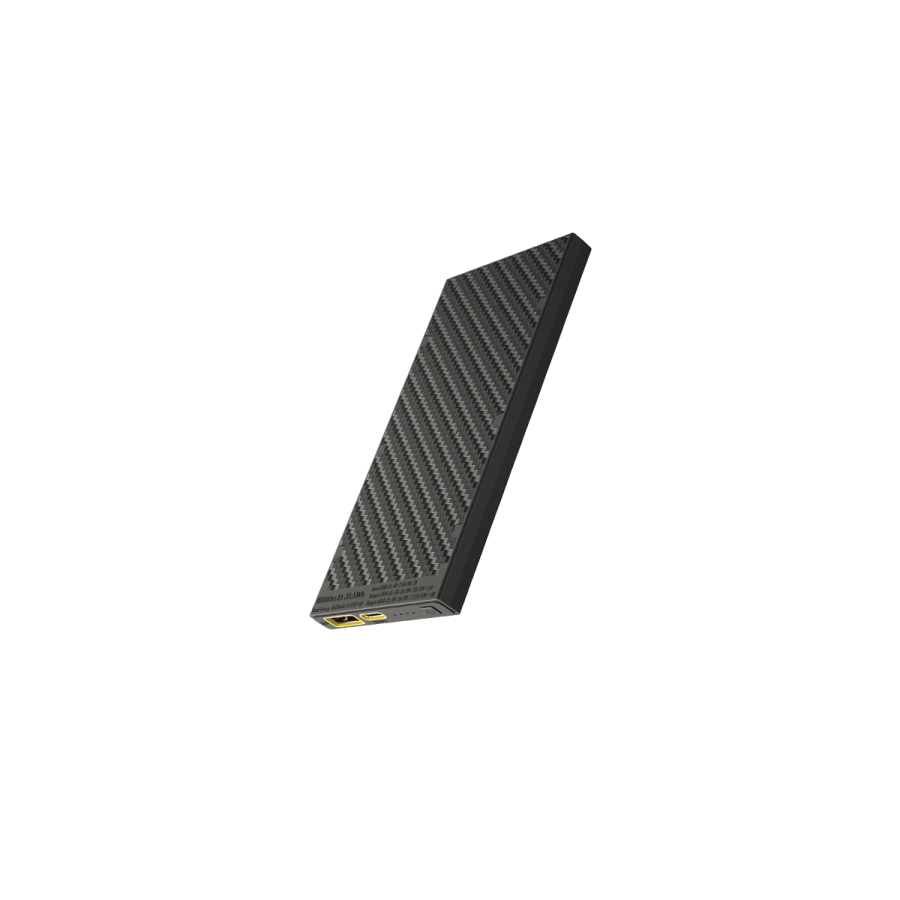
The Nitecore NB10000 Gen 2 is the lightest pick here at just 150g, with a carbon-fibre body, IPX5 rating, USB-C 20W PD, USB-A 18W and a low-current mode for earbuds and watches. Its 10,000mAh at 3.85V equals 38.5Wh; Nitecore rates usable capacity at 6,400mAh. $59.95 at Nitecore Store — check current price on Amazon.
3. TORRAS MiniMag 10K — best magnetic / MagSafe pick
The TORRAS MiniMag snaps magnetically onto iPhones and charges at 15W MagSafe wirelessly, or 22.5W over a cable. It is 0.65 inches thick, weighs about 205g and has a ring stand. Expect fewer charges over MagSafe than over a cable. It lists around $80, often on sale — check current price on Amazon. Compare it in our TORRAS MiniMag vs Anker MagGo comparison.
4. Anker MagGo Power Bank 10K (Qi2) — magnetic alternative

The Anker MagGo 10K (model A1654) offers 15W Qi2 wireless plus 30W USB-C wired output, with a magnetic snap-on fit for iPhone 12 and later. Use the cable for the fastest top-ups, the magnet for pocket convenience. List price is around $89.99, with sales seen at $69.99–$71.99 — check current price on Amazon.
Common mistakes to avoid
- Buying on the printed mAh alone. Two banks labelled 10,000mAh can deliver very different usable charge — check wattage and efficiency, not just the headline capacity.
- Using a 10W bank and expecting fast charging. A low-wattage bank charges slowly no matter its size. iPhone 15 or later needs 20W or greater USB-C PD.
- Expecting 2 charges from a MagSafe bank. Wireless charging loses far more energy than a cable — a magnetic 10,000mAh bank may give a Pro Max only about one charge.
- Buying a no-name bank with poor efficiency. Cheap banks with weak efficiency can waste nearly half the stored energy — stick to brands that publish real specs.
FAQ
How many times can a 10,000mAh power bank charge an iPhone?
About 1.5–2 times. A standard iPhone 16 gets about 2 full charges, a Pro Max about 1.5 — only around 7,000mAh of the rated 10,000mAh is usable. Check our Power Bank Calculator for your model.
Is a 10,000mAh power bank good for an iPhone?
Yes, for everyday use. It covers a full day plus a buffer, fits in a pocket, and at 37Wh is well under the 100Wh airline carry-on limit. Not for multi-day trips, two devices or a tablet — that is 20,000mAh territory.
Why doesn't a 10,000mAh power bank deliver 10,000mAh to my phone?
The rating is quoted at the cells' 3.7V; USB output runs at 5V. Conversion alone drops the maximum to 7,400mAh, and 80–90% efficiency leaves roughly 6,000–7,000mAh usable. Anker's rule of thumb: multiply the rated capacity by 0.6 to 0.7. See Anker: How to Check Capacity of Power Bank.
Can I take a 10,000mAh power bank on a plane?
Yes. A 10,000mAh bank holds about 37Wh, well under the 100Wh carry-on limit; a 20,000mAh bank at about 74Wh is also under it. Carry-on only — never checked luggage.
Is 10,000mAh enough for a day trip or travel?
For one day trip with one iPhone, yes — about two charges is plenty. For a weekend with no outlet, no: get a 20,000mAh bank, about 14,000mAh usable, or about 3 charges for a Pro Max.
Does wireless (MagSafe) charging waste more power than a cable?
Yes. Magnetic transfer is typically 75 to 80 percent efficient, versus 85 to 90 percent for wired USB-C, and end-to-end wireless efficiency drops to around 50–55%. A MagSafe 10,000mAh bank barely charges a Pro Max once — use a cable for the maximum count.
Sources & References
- Macworld, "iPhone batteries compared" (Sep 18, 2026): macworld.com
- TidBITS, iPhone Battery Life Specs: tidbits.com
- Notebookcheck, iPhone 17 battery capacities (EU energy labels): notebookcheck.net
- Anker, "How to Check Capacity of Power Bank": anker.com
- Anker, "Is a 10,000mAh Power Bank Good?": anker.com
- Anker, "How to Choose a Power Bank for iPhone": anker.com
- Apple Support, "Fast charge your iPhone": support.apple.com


0 Comments