Tech Gear Hub compares the Sony ZV-E10 II vs Canon EOS R50 in this Cameras guide for US beginners, because these are the two mirrorless cameras most new creators ask us about first. If you want one camera that can shoot sharp photos, clean 4K video and grow with you as you learn, this Sony ZV-E10 II vs Canon EOS R50 comparison gives you the honest answer, not just a spec sheet.
As an Amazon Associate I earn from qualifying purchases. Prices change often, so check the current price before you buy.
By Tech Gear Hub • Last updated: November 2, 2026
Quick Verdict
For most beginners, the Canon EOS R50 is the better buy. It costs $500 less than the Sony kit, has a viewfinder, feels like a real camera in the hand, and its autofocus and 4K video are excellent for YouTube, family photos and travel. Buy the Sony ZV-E10 II only if video is your main job and you specifically need 4K at 60 frames per second with 10-bit color.
Contents
- Sony ZV-E10 II vs Canon EOS R50: Full Specs Compared
- Video: Where Sony Pulls Ahead
- Photos and Autofocus
- Sony ZV-E10 II: Pros and Cons
- Canon EOS R50: Pros and Cons
- Our 10-Point Scores
- Who Should Buy Each Camera
- Frequently Asked Questions
Sony ZV-E10 II vs Canon EOS R50: Full Specs Compared
Both cameras use an APS-C sensor, which is larger than a phone sensor and far larger than the sensor in most compact cameras. That size is the whole point: it gives you softer background blur, cleaner low-light photos and a more professional look without the cost and weight of a full-frame camera. Sony lists a 26-megapixel APS-C sensor for the ZV-E10 II, while Canon lists a 24.2-megapixel APS-C sensor for the EOS R50, according to their official product pages. In everyday use, that 1.8-megapixel gap will not decide a single photo for you.
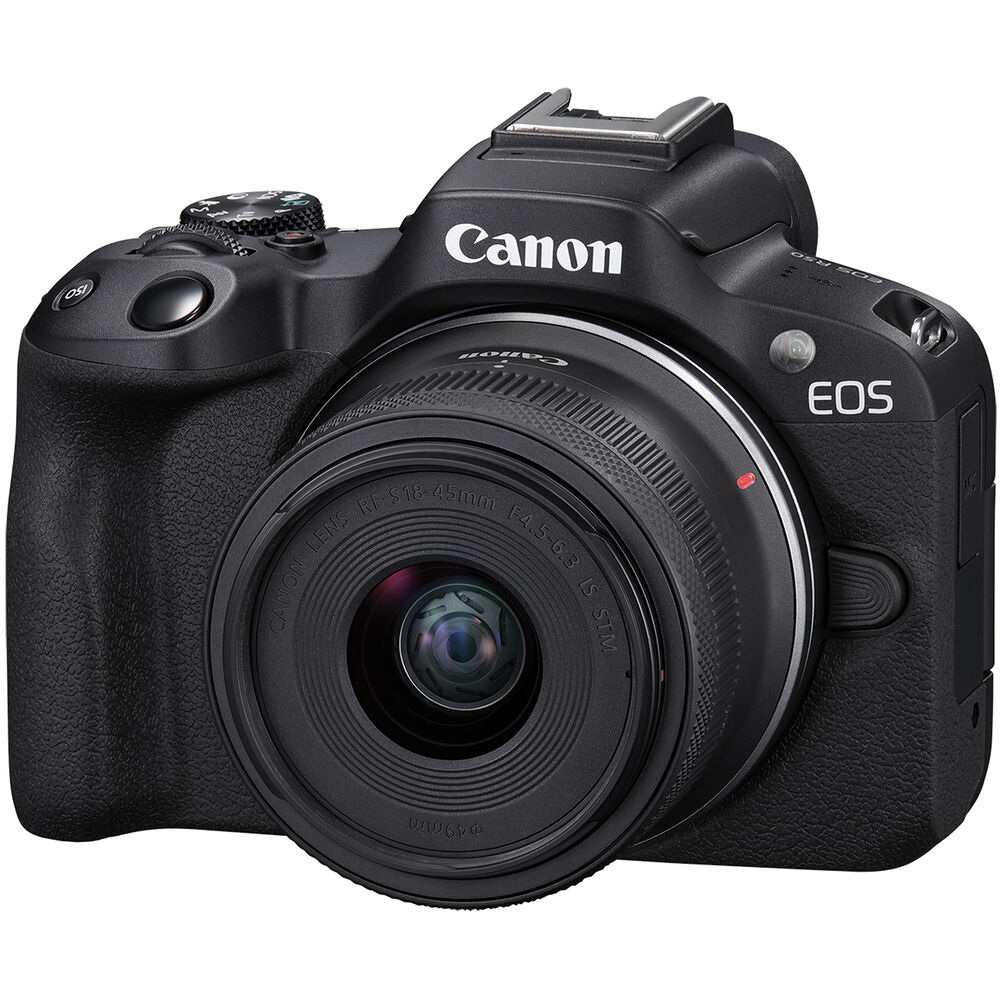
The price gap, however, is impossible to ignore. Sony lists the ZV-E10 II with the 16-50mm lens at $1,299.99 on Sony USA, while Canon lists the EOS R50 with the RF-S 18-45mm lens at $799.99, down from $899.99, on Canon USA. That is exactly $500.00 more for the Sony kit, money that could buy a second lens, a good microphone, a tripod and memory cards for the Canon. Prices were checked on November 2, 2026, and both kits are sold in the USA with a kit zoom lens, so neither buyer needs to buy a lens on day one.
| Feature | Sony ZV-E10 II with 16-50mm lens | Canon EOS R50 with RF-S 18-45mm lens |
|---|
| Sensor | 26-megapixel APS-C | 24.2-megapixel APS-C |
| Video | 4K up to 60 fps, 10-bit 4:2:2 | 4K up to 30 fps, oversampled from 6K |
| Autofocus | 759 phase-detection points, real-time tracking | Dual Pixel CMOS AF II |
| Viewfinder | None, screen only | Built-in electronic viewfinder |
| Screen | Vari-angle touchscreen | Vari-angle touchscreen |
| Stabilization | Electronic in body, lens stabilization on kit lens | Lens stabilization on kit lens, no in-body stabilization |
| Weight, body | About 377 grams | About 375 grams |
| US kit price, checked Nov 2, 2026 | $1,299.99, Sony USA | $799.99, was $899.99, Canon USA |
One quotable fact sums up the value question: the Sony kit costs $1,299.99 while the Canon kit costs $799.99, a $500.00 difference for two cameras with the same size of sensor. Another quotable fact sums up the video question: Sony records 4K video at up to 60 frames per second, while Canon tops out at 30 frames per second in 4K. If you slow footage down or grade color heavily, Sony wins. If you post straight to YouTube, Canon 4K is already more than sharp enough.
Video: Where Sony Pulls Ahead
Sony built the ZV-E10 II for creators first. It has a three-capsule microphone on top, a wind shield in the box, a dedicated background-defocus button and a product-showcase mode that shifts focus to an item held up to the lens. For a solo YouTuber filming in a bedroom or a studio, those touches save real editing time. The headline advantage is video quality: 4K at 60 frames per second with 10-bit color gives smoother motion and more room to adjust color afterward than Canon 4K at 30 frames per second. Sony also offers S-Log profiles for creators who want a flat, gradeable picture.
Canon is no slouch for video, though. Its 4K footage is oversampled from 6K, according to Canon USA, which means it starts from a higher-resolution readout and downsamples it, keeping detail clean. Dual Pixel CMOS AF II keeps faces locked on, and the vari-angle screen flips forward so you can see yourself while vlogging. The honest limit is frame rate: if you want slow-motion 4K, Canon cannot do it, and you will need to shoot in Full HD for slow motion instead. For talking-head videos, tutorials, travel clips and family films, that limit rarely matters.
Audio matters as much as resolution, and both cameras accept an external microphone, which we recommend for any serious channel. The Sony built-in microphone is the better starting point, but a $50 to $100 external mic on either camera will beat both built-in mics. Do not let a built-in microphone decide a $500 purchase.
Photos and Autofocus
For still photos, this comparison is much closer than the video gap suggests. Both cameras focus quickly, track eyes and faces, and produce sharp images in daylight. Canon color science is famous for pleasing skin tones straight out of camera, which means less editing for portraits and family photos. Sony images are a little more neutral and detailed, which suits photographers who like to edit their own files. Neither look is objectively better; it is a taste question, and both can be adjusted in camera or in editing software.
In low light, both APS-C sensors perform well for beginners, but neither is a miracle worker with a slow kit lens. The kit lenses here are f/3.5-5.6 for Sony and f/4.5-6.3 for Canon at their widest, so indoor evening shots will need higher ISO settings or a faster prime lens later. That is normal at this price. The good news is that both systems have affordable fast primes, and Sony E-mount and Canon RF mount both offer a 50mm f/1.8 lens that transforms low-light and portrait shooting for a modest price. Buy the camera first, learn it, and add that prime as your second lens.
Handling is where Canon earns its price advantage back for many buyers. The EOS R50 has a proper grip, a viewfinder for bright sunlight, and a menu system that feels designed for someone holding their first interchangeable-lens camera. The Sony is a video-first body: it is compact, its screen is excellent, but composing in bright sun without a viewfinder can be frustrating, and stills photographers may miss the viewfinder every single day. If you plan to shoot as many photos as videos, try to hold both before you buy. Ergonomics are personal, and no spec table can replace five minutes in a store.
Sony ZV-E10 II: Pros and Cons
The Sony ZV-E10 II is the creator tool. Its 26-megapixel sensor, 759 autofocus points and 4K60 10-bit video put it ahead on pure video capability, and Sony huge E-mount lens range means you will never run out of upgrade paths. The larger NP-FZ100 battery is another real-world plus for long filming days, and the vari-angle touchscreen makes self-filming simple.
Pros: Best-in-class 4K60 10-bit video for the price; excellent autofocus and tracking; superb built-in microphone with wind shield; huge lens ecosystem; long battery life for a camera this size.
Cons: No viewfinder, which hurts in bright light; no in-body image stabilization; $1,299.99 kit price is $500 more than Canon; video-first controls can feel awkward for pure photographers; kit lens is slow in low light.
Check the current price of the Sony ZV-E10 II with 16-50mm lens on Amazon at https://www.amazon.com/dp/B0D92VDW76?tag=mohammad107-20 . Also see the official Sony ZV-E10 II product page at https://electronics.sony.com/imaging/interchangeable-lens-cameras/aps-c/p/zve10m2kb for full specifications.
Canon EOS R50: Pros and Cons
The Canon EOS R50 is the beginner camera. It does almost everything well, nothing badly, and it leaves $500 in your pocket compared with Sony. Its 24.2-megapixel sensor, Dual Pixel autofocus and oversampled 4K video produce images and footage that look great on YouTube, Instagram and in print, and the viewfinder plus friendly menus make it the easier camera to learn on. At $799.99 on Canon USA, it is also the better value by a clear margin.
Pros: Much lower price at $799.99; built-in viewfinder; friendly beginner menus and grip; excellent autofocus and pleasing colors; compact and light at about 375 grams.
Cons: 4K video limited to 30 frames per second; no in-body image stabilization; kit lens is slow at f/4.5-6.3 in low light; RF-S lens range is smaller than Sony E-mount range; no 10-bit video for heavy color grading.
See the official Canon EOS R50 lens kit page at https://www.usa.canon.com/shop/p/eos-r50-rf-s18-45mm-f4-5-6-3-is-stm-lens-kit for the current $799.99 price and full specifications.
Links: Check the Sony ZV-E10 II price on Amazon. Official pages: Sony ZV-E10 II official page and Canon EOS R50 official page. Related guides: MacBook Air M4 vs MacBook Pro M4 comparison, Galaxy S25 vs S24 buying guide, iPhone 16 vs iPhone 15 verdict.
Our 10-Point Scores
These are Tech Gear Hub own scores, not a manufacturer claim. We scored each camera out of 10 for the three things beginners actually feel every day: video quality, photo quality and overall value in the USA.
| Category | Sony ZV-E10 II | Canon EOS R50 |
|---|
| Video | 9.5/10 | 8.0/10 |
| Photos | 8.5/10 | 8.5/10 |
| Value | 7.5/10 | 9.5/10 |
Sony wins video by a clear margin, photos are a tie, and Canon wins value by a clear margin. That is why the verdict depends on your main use: video-first creators should pay for Sony, while everyone else should keep the $500 and buy Canon.
Who Should Buy Each Camera
Buy the Sony ZV-E10 II if: you film YouTube videos weekly, you want 4K slow motion or 10-bit color grading, you already own Sony E-mount lenses, or you mainly shoot video and rarely use a viewfinder. Buy the Canon EOS R50 if: you are buying your first mirrorless camera, you shoot photos and video in roughly equal amounts, you want a viewfinder and simple menus, or you want the best value and plan to spend the savings on a microphone or a fast prime lens.
Who should NOT buy either camera: If you need professional full-frame low-light performance, weather sealing for harsh outdoor work, or 4K at 120 frames per second, skip both and save for a higher-tier body. If you only shoot on a phone and never plan to learn lenses, editing or manual settings, a flagship phone will serve you better than either camera. And if your budget is under $500, neither kit fits, so look for a used earlier model instead of stretching for a new kit you cannot afford to accessorize.
Our final take is simple. The Sony ZV-E10 II is the better video camera, the Canon EOS R50 is the better beginner camera, and for most US buyers in 2026 the Canon is the smarter first purchase. Check current prices, hold both if you can, and buy the one you will actually carry every day, because the best camera is the one you use.
Sources: sensor, video and price details per Sony USA and Canon USA official product pages linked above; ranking context per live search results showing small blogs, forums and creator sites ranking for this comparison alongside DPReview.
Frequently Asked Questions
Is the Sony ZV-E10 II better than the Canon EOS R50?
For video, yes, Sony offers 4K60 with 10-bit color, while Canon offers 4K30. For photos and value, Canon matches Sony and costs $500 less, so it is better for most beginners.
Which camera is better for vlogging?
Sony, thanks to its creator-focused microphone, product-showcase mode and 4K60 video. Canon is still a strong vlogging camera with its flip screen and reliable autofocus, at a lower price.
Does the Canon EOS R50 have a viewfinder?
Yes. The EOS R50 has a built-in electronic viewfinder, while the Sony ZV-E10 II does not, a key difference in bright sunlight.
Is the Sony ZV-E10 II good for beginners?
Yes, for video beginners. Its autofocus and creator modes are friendly, but stills beginners may miss the viewfinder and prefer Canon simpler handling.
How much do these cameras cost in the USA?
Checked November 2, 2026: the Sony ZV-E10 II kit is $1,299.99 on Sony USA, and the Canon EOS R50 kit is $799.99, down from $899.99, on Canon USA.
Do I need a new lens right away?
No. Both kits include a zoom lens that covers everyday photos and video. Add a fast 50mm f/1.8 prime later for portraits and low light.




Comments
Post a Comment