
By Tech Gear Hub • Last updated: November 10, 2026
As an Amazon Associate, Tech Gear Hub earns from qualifying purchases made through links on this page, at no extra cost to you. Prices change often, so check the current price on Amazon before you buy.
Tech Gear Hub compares the two most popular beginner mirrorless cameras of 2026 in this head-to-head: the Canon EOS R50 and the Nikon Z30. Both are compact APS-C mirrorless cameras built for people buying their first serious camera, and both shoot sharp 4K video, but they solve the beginner problem in opposite ways. Canon gives you a real viewfinder and its best beginner autofocus, while Nikon drops the viewfinder entirely and builds the simplest vlogging camera it can. This Canon EOS R50 vs Nikon Z30 comparison covers image quality, autofocus, video, handling, lenses, and price, so you can pick the right one the first time.
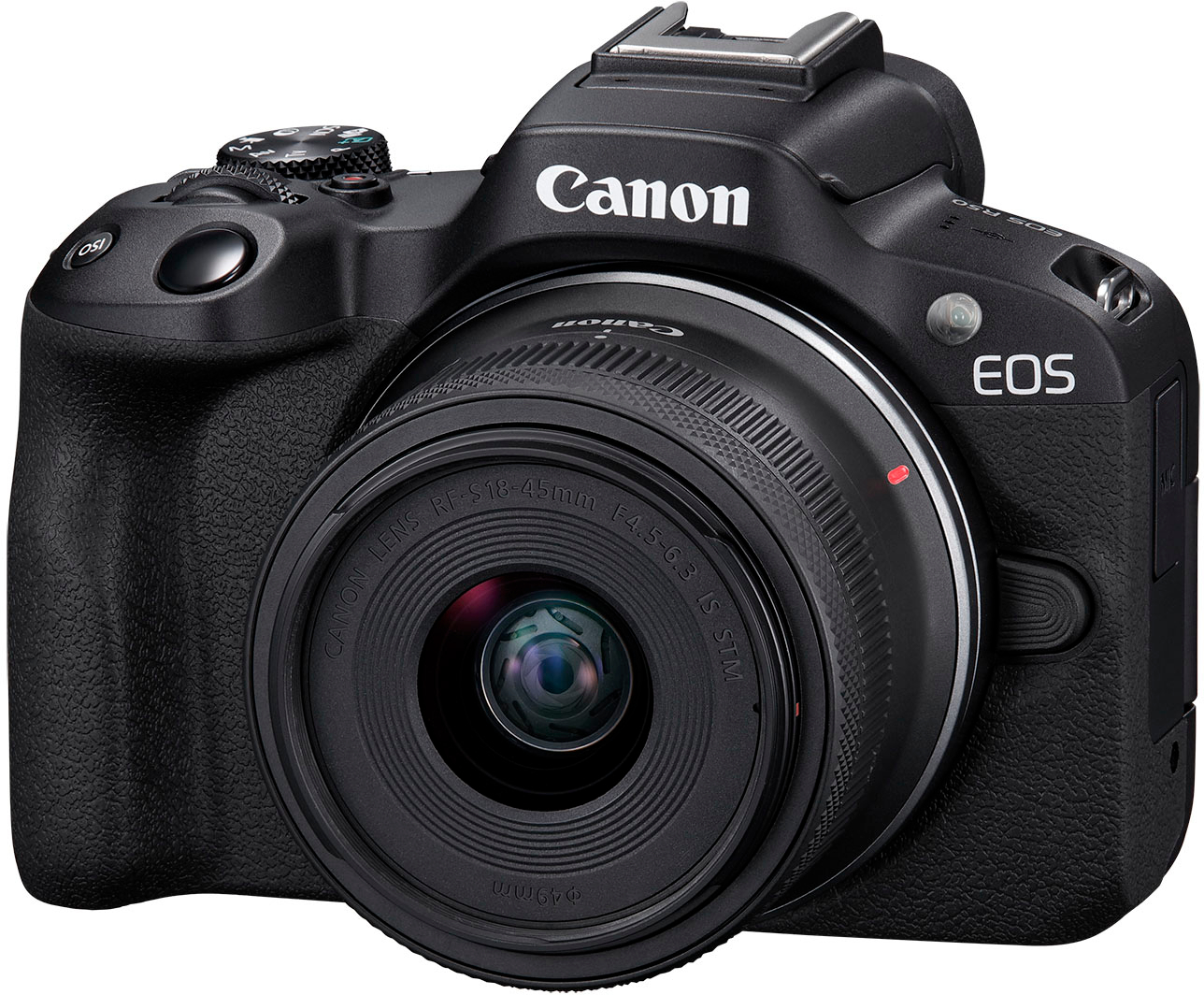
The Canon EOS R50 with its RF-S 18-45mm kit lens. Photo: Best Buy product image.
Quick Verdict
Quick Verdict: Buy the Nikon Z30 if you mainly vlog or film yourself: it is simpler, lighter, and cheaper on sale. Buy the Canon EOS R50 if you shoot photos and video equally: its viewfinder and Dual Pixel CMOS AF II autofocus are better. For most first-time buyers, the R50 is the safer all-rounder; the Z30 is the better creator camera.
Table of Contents
- Quick Verdict
- Canon EOS R50 vs Nikon Z30: Specs at a Glance
- Our Scores: How We Rate Each Camera
- Image Quality: 24.2MP vs 20.9MP
- Autofocus: Dual Pixel CMOS AF II vs 209-Point Hybrid AF
- Video and Vlogging
- The Canon EOS R50 in Detail
- The Nikon Z30 in Detail
- Handling, Battery and Everyday Use
- Lenses and the System Around Each Camera
- Price and Value in 2026
- The EOS R50 V Alternative
- Who Should NOT Buy These Cameras
- Final Verdict: Which Beginner Camera Should You Buy?
- Frequently Asked Questions
Canon EOS R50 vs Nikon Z30: Specs at a Glance
Before the detail, here is the honest spec sheet. Every number below comes from Canon and Nikon official pages or their launch announcements, not from a rumor site.
| Specification | Canon EOS R50 | Nikon Z30 |
|---|---|---|
| Sensor | 24.2MP APS-C CMOS | 20.9MP APS-C (DX) CMOS |
| Image processor | DIGIC X | EXPEED 6 |
| Autofocus | Dual Pixel CMOS AF II, up to 651 zones, 100% frame coverage | 209-point hybrid AF with eye detection |
| Viewfinder | Yes — 0.39-inch OLED EVF, approx. 2.36 million dots | No viewfinder — rear screen only |
| Screen | 3.0-inch vari-angle touchscreen, 1.62 million dots | 3.0-inch flip-out touchscreen, 1.04 million dots |
| Video | Uncropped 4K30 oversampled from 6K; Full HD 120fps; up to 1 hour continuous recording | Uncropped 4K30; Full HD 120fps; up to 125 minutes continuous recording in Full HD |
| 4K60 | No | No |
| In-body stabilization | No (lens IS only) | No (lens VR only) |
| Continuous shooting | Up to 12 fps (electronic first curtain), 15 fps (electronic shutter) | Up to 11 fps |
| Recording limit | 1 hour per clip | No 30-minute limit |
| Weight (body) | Approx. 375 g (body only, approx. 13.2 oz with battery and card) | Approx. 405 g |
| Launch body-only price | $679.99 | $709.95 |
| Best for | Hybrid photo and video creators | Vloggers and first-time creators |
The Canon EOS R50 records uncropped 4K30 video oversampled from 6K, while the Nikon Z30 records uncropped 4K30 and can keep recording for up to 125 minutes in Full HD. That single sentence tells you most of what matters: the R50 gives you the sharper, more detailed 4K file, and the Z30 gives you the longer, simpler take.
Our Scores: How We Rate Each Camera
These are Tech Gear Hub's own scores, out of 10, judged for a beginner buyer in 2026. They follow directly from the strengths and weaknesses in this article — the R50 wins on autofocus and stills, the Z30 wins on vlogging simplicity and value.
| Category (out of 10) | Canon EOS R50 | Nikon Z30 |
|---|---|---|
| Image quality | 8.8 | 8.4 |
| Autofocus | 9.2 | 8.5 |
| Video and vlogging | 8.6 | 8.9 |
| Ease of use | 8.4 | 9.0 |
| Value for money | 8.5 | 9.1 |
| Overall | 8.7 | 8.8 |
The overall scores are almost tied, and that is the honest result. The Z30 edges ahead by a tenth of a point because it is cheaper on sale and easier to live with as a first camera, but the R50 wins two of the five categories outright and is the stronger camera for anyone who cares about stills. Read the sections below before you let that tenth of a point decide anything.
Image Quality: 24.2MP vs 20.9MP
On paper, the Canon EOS R50 has the resolution advantage: a 24.2-megapixel APS-C sensor against the Nikon Z30's 20.9-megapixel APS-C sensor. In real photos, that gap is smaller than the numbers suggest, but it is real. The R50's extra 3.3 megapixels give you more room to crop, and Canon's DIGIC X processor keeps noise well controlled at higher ISOs, so night shots and indoor photos hold up nicely for a camera at this price.
The Z30's 20.9-megapixel sensor is the same resolution class Nikon has used in its well-regarded Z50, and it produces clean, natural-looking files with good color. For social media, YouTube thumbnails, and prints up to normal sizes, you will not see a difference between these two cameras. Where you will see it is in heavy cropping — wildlife, sports, or reframing a portrait in editing — and there the R50's files simply have more data to work with.
Both cameras shoot RAW as well as JPEG, which matters more than the megapixel gap for a beginner who wants to learn editing. RAW files from either camera give you real room to fix exposure and white balance later. Both also rely on lens stabilization rather than in-body stabilization, so neither camera will save a shaky handheld shot on its own — you need a stabilized lens or a tripod for slow shutter speeds, and that is a genuine shared weakness.
Image quality winner: Canon EOS R50. The higher resolution and DIGIC X processing give it the edge, even though the Z30's image quality is perfectly good for the audience these cameras are made for.
Autofocus: Dual Pixel CMOS AF II vs 209-Point Hybrid AF
Autofocus is where the Canon EOS R50 pulls clearly ahead, and it is the biggest reason to choose it. The R50's Dual Pixel CMOS AF II covers up to 100% of the frame with 651 automatically selected AF zones, and it uses deep-learning subject detection to find and track people, animals, and vehicles. In practice, that means the camera locks onto an eye and stays on it, even when your subject moves across the frame.
The Nikon Z30's hybrid AF system uses 209 focus points with eye detection for people and pets, and it is fast and reliable for the vlogging and everyday shooting it was designed for. For a person talking to camera, or a pet sitting still, it rarely misses. The difference shows up in harder situations: a child running toward you, a dog sprinting across a park, or a subject at the edge of the frame. The R50's system covers the whole frame and tracks more stubbornly; the Z30's system is good, but it has fewer points and less coverage to work with.
The R50's Dual Pixel CMOS AF II covers up to 100% of the frame with 651 AF zones, while the Z30's hybrid AF system uses 209 focus points. If you film yourself mostly sitting or standing in one place, either system will serve you well. If you photograph kids, pets, or sports, the R50's autofocus is worth real money.
Autofocus winner: Canon EOS R50, by a clear margin.
Video and Vlogging
This is the Z30's home ground, and Nikon designed the whole camera around it. The Z30 has a flip-out front-facing touchscreen so you can see yourself while recording, a red tally light on the front so you always know when you are rolling, a built-in stereo microphone, and a simple creator-friendly menu system. It records uncropped 4K30 with no 30-minute recording limit, and Nikon rates it for more than two hours — 125 minutes — of continuous Full HD recording. For long talking-head videos, tutorials, podcasts, and livestreams, that matters: you press record and stop worrying about the camera.
The R50 is no slouch on video. Its 4K30 is oversampled from 6K, which means the footage is sharper and more detailed than the Z30's 4K, and it offers Full HD at up to 120 frames per second for smooth slow motion, plus a Movie for Close-up Demos mode that snaps focus to a product you hold up to the lens — genuinely useful for product reviews and unboxings. It also works as a plug-and-play webcam over USB, and it can record continuously for up to 1 hour per clip. The catch is that 1-hour ceiling: for most creators it is plenty, but for a two-hour podcast or a long livestream, the Z30's longer recording time wins.
Neither camera shoots 4K60, and neither has in-body stabilization, so walking-and-talking footage will need a stabilized lens or a small gimbal for the smoothest results. Both cameras shoot vertical video with the correct metadata for phones, which matters if your audience lives on TikTok, Instagram Reels, and YouTube Shorts.
Video winner: Nikon Z30, narrowly. The R50's footage is sharper, but the Z30's longer recording, tally light, and simpler vlogging design make it the easier camera to film with every day.
The Canon EOS R50 in Detail

The Canon EOS R50, front view with the RF-S 18-45mm kit lens. Check the current price of the Canon EOS R50 kit on Amazon.
The Canon EOS R50 is the camera for the beginner who wants to grow. Its headline feature is the eye-level electronic viewfinder — a 0.39-inch OLED EVF with about 2.36 million dots — and it changes how you shoot. In bright sunlight, when a rear screen washes out, the viewfinder gives you a clear, bright image. When you want a steady shot, bracing the camera to your eye beats holding it at arm's length. The Z30 has no viewfinder at all, so if you plan to shoot photos outdoors in daylight, this alone can justify the R50. For the detailed verdict and sample results, read our full Canon EOS R50 review.
The R50 is also the faster stills camera. It shoots up to 12 frames per second with the electronic first-curtain shutter and up to 15 frames per second with the full electronic shutter, against the Z30's 11 frames per second. That is a small gap on paper, but combined with the better autofocus, it makes the R50 the better choice for action, kids, and pets.
Where the R50 frustrates is battery life and video ceiling. The small LP-E17 battery is the camera's weakest point — heavy 4K recording drains it fast, and you should budget for a spare battery from day one. Canon rates the R50 for about 1 hour of continuous 4K30 recording per charge in independent testing, so a long shoot needs spares or USB power. There is also no 4K60 and no C-Log picture profile, so if your ambitions grow toward serious color grading or slow-motion 4K, you will outgrow the R50's video specs sooner than its stills specs.
Canon EOS R50 pros:
- Best-in-class beginner autofocus with 651 AF zones and deep-learning subject tracking
- Real OLED electronic viewfinder — a genuine advantage in bright light
- Sharper 6K-oversampled 4K30 video and Full HD 120fps slow motion
- Higher 24.2MP resolution with more cropping room
- Faster burst shooting: up to 15 fps with the electronic shutter
- Useful creator modes, including Movie for Close-up Demos and vertical video
Canon EOS R50 cons:
- Small battery — about 1 hour of continuous 4K30 per charge
- No 4K60 and no C-Log for advanced video work
- No in-body stabilization
- Single UHS-I SD card slot
If you are also considering Sony's beginner vlogging camera, our Sony ZV-E10 II vs Canon EOS R50 comparison puts the R50 against a camera that, like the Z30, skips the viewfinder entirely.
The Nikon Z30 in Detail

The Nikon Z30 with a NIKKOR Z DX lens. Photo: Nikon official product image. Check the current price of the Nikon Z30 kit on Amazon.
The Nikon Z30 is the simplest camera in this comparison, and that is a compliment. Nikon removed the viewfinder, removed the complicated dials, and built a camera that a first-time creator can pick up and use in minutes. The flip-out screen faces forward for self-recording, the menus are plain-language, and the camera leans on automatic modes that get the exposure right without a photography lesson first.
At about 405 grams, the Z30 is light enough to carry all day and small enough to disappear into a bag with the collapsible 16-50mm kit lens. That kit lens is genuinely good for the price: sharp, compact, and wide enough at 16mm for arm's-length vlogging. The camera also streams easily — plug-and-play webcam use over USB-C in Full HD, and 4K30 streaming over HDMI — which makes it a strong pick if your videos double as livestreams or video calls.
The trade-off for all that simplicity is that the Z30 is the less capable stills camera. Without a viewfinder, composing photos in bright sunlight means squinting at the rear screen, and the 20.9MP sensor and 11 fps burst are a step behind the R50 for action. The Z30 is also a camera you will outgrow faster if photography becomes your main hobby: it has no viewfinder to grow into, and its controls are designed for auto modes first.
Nikon Z30 pros:
- Simplest camera here — the easiest first camera to learn
- Flip-out selfie screen, front tally light, and built-in stereo mic built for vlogging
- Long recording times: up to 125 minutes in Full HD, no 30-minute limit
- Light and compact at about 405 g
- Eye-detection autofocus for people and pets that works well for creators
- Often the cheapest option — regularly on sale under $600 with the kit lens
Nikon Z30 cons:
- No viewfinder — painful in bright sunlight
- Lower 20.9MP resolution with less cropping room
- Autofocus has fewer points (209) and less frame coverage than the R50
- No in-body stabilization
- Fewer physical controls for photographers who want manual control
Handling, Battery and Everyday Use
Hold both cameras and the difference is immediate. The R50 feels like a small camera that wants to be a photographer's camera: it has a viewfinder hump, a proper grip, and enough dials to take control when you are ready. The Z30 feels like a creator's tool: flatter on top where the viewfinder would be, cleaner, and lighter in the hand. Both are genuinely portable, and neither will weigh you down on a day out.
Battery life is a weakness for both, but it bites the R50 harder because its 4K recording is more demanding. Plan on a spare battery for either camera if you shoot video seriously, and use USB-C power for long static recordings — both cameras support constant power over USB-C, which is how creators run multi-hour streams without swapping batteries. The Z30's longer recording times per charge make it the lower-stress choice for long takes.
On screens, the R50's display is the better panel: 1.62 million dots against the Z30's 1.04 million, and both are fully touch-capable with vari-angle or flip-out movement. In practice, both screens are fine for framing and menu use; the R50's is simply crisper when you zoom in to check focus.
Both cameras have a single SD card slot, Wi-Fi and Bluetooth for phone transfers, and a microphone jack for an external mic — which you should buy before any other accessory if you care about sound. Neither camera is weather-sealed, so treat both gently in rain and dust.
Lenses and the System Around Each Camera
A beginner camera is only as good as the lenses you can afford for it, and this is where the two systems start to pull apart. Canon's RF-S lens range for APS-C cameras is still growing, but the kit options are strong: the collapsible RF-S 18-45mm is small and sharp enough for everyday use, and the RF-S 55-210mm adds affordable telephoto reach. Crucially, the R50 can also use Canon's full-frame RF lenses, which gives you a huge upgrade path — from cheap primes like the RF 50mm f/1.8 to professional L-series glass — without changing camera bodies.
Nikon's Z-mount DX lens range is smaller but well chosen for creators. The 16-50mm kit lens is excellent, the 50-250mm telephoto is affordable and sharp, and the newer 12-28mm power-zoom lens is made for vloggers who want a wider selfie angle. Nikon Z cameras can also use full-frame Z lenses, so the upgrade path exists here too. Where Nikon lags is in affordable third-party support: Canon's RF mount has attracted more budget lenses in recent years, while Nikon's DX range depends more on Nikon's own lenses.
For a first-time buyer, either kit lens will cover the first year of shooting. The practical advice is simple: buy the kit, shoot with it for six months, and only then decide whether you need a wide prime for low light or a telephoto for reach. Both mounts will still be there when you are ready.
Price and Value in 2026
At launch, the Canon EOS R50 body cost $679.99 and the Nikon Z30 body cost $709.95 — nearly identical prices for two cameras with very different priorities. In 2026, the street prices have drifted apart in Nikon's favor. The Z30 kit with the 16-50mm lens has recently been listed around $557 on Amazon, a steep discount from its launch price, and it regularly appears on sale under $600 with the kit lens. The R50 holds its price better, which is good for resale value but means you will usually pay more for the Canon kit than the Nikon kit.
Check the current price of both cameras before you buy, because camera prices move with sales and stock. As a rule of thumb, if the two kits are within $50 of each other, the R50 is the better buy for most people because of its viewfinder and autofocus. If the Z30 kit is $100 or more cheaper — which it often is — it becomes very hard to argue against for a vlogger or a first-time creator on a budget.
Do not forget the real cost of ownership. Both cameras need the same extras: a spare battery, a fast SD card, and a microphone if you record video seriously. Budget roughly $80 to $120 for those basics on top of the camera price, whichever one you choose.
Check the current price of the Canon EOS R50 kit on Amazon and check the current price of the Nikon Z30 kit on Amazon before deciding — the gap between them changes from week to week.
The EOS R50 V Alternative
Before you decide, know that Canon sells a video-focused spin-off: the EOS R50 V, launched in 2025. It uses the same 24.2MP sensor and Dual Pixel CMOS AF II autofocus as the R50, but it adds 4K60 video (in crop mode), a power-zoom lever, and video-first controls, at around $649 for the body. The catch is that it drops the electronic viewfinder entirely — like the Z30 — so it is a video camera first and a stills camera second.
The R50 V is worth a look if you are sure video is your priority and you want 4K60, but it is not a replacement for the regular R50 in this comparison. If you want a viewfinder and the best hybrid balance, the standard R50 is still the right Canon. Do not confuse the two when shopping: the "V" matters, and listings sometimes bury it in the fine print.
Who Should NOT Buy These Cameras
Who should NOT buy the Canon EOS R50: Skip it if you only ever film yourself and never take photos — you are paying for a viewfinder and stills autofocus you will not use, and the Z30 is cheaper and simpler. Skip it too if you need 4K60 or professional log video; neither camera offers it, and you should look at the R50 V or a higher-end body instead.
Who should NOT buy the Nikon Z30: Skip it if photography matters as much as video to you. The missing viewfinder and the weaker autofocus will frustrate you outdoors and with moving subjects. Skip it too if you shoot sports, wildlife, or fast-moving kids — the R50's autofocus and burst speed are worth the extra money there.
Who should buy neither: If you need in-body stabilization, weather sealing, dual card slots, or 4K60, neither of these cameras fits. Both are beginner cameras with beginner compromises, and pretending otherwise would be dishonest. For action cameras and rugged shooting instead, see our GoPro Hero 13 Black vs DJI Osmo Action 5 Pro comparison.
Final Verdict: Which Beginner Camera Should You Buy?
There is no wrong answer here, but there is a right answer for you, and it depends on what you will actually do with the camera. The Nikon Z30 is the better vlogging camera and the better first camera: it is simpler, lighter, cheaper on sale, and it records longer without fuss. If your plan is YouTube, TikTok, or livestreaming, and photos are a secondary thought, buy the Z30 and spend the money you save on a microphone and a spare battery.
The Canon EOS R50 is the better all-round camera and the better long-term buy: its viewfinder, its 651-zone autofocus, its sharper 4K, and its 24.2MP sensor make it the stronger hybrid for someone who shoots photos and video in equal measure. If you want one camera that grows with you from beginner to serious hobbyist, buy the R50.
Our scores give the Z30 the narrowest of overall wins — 8.8 against 8.7 — on the strength of its value and vlogging ease. But scores do not shoot your photos. If you will use a viewfinder, or photograph anything that moves, the R50 is the camera to buy despite that tenth of a point. If you will mostly talk to a camera, the Z30 is the camera to buy, and you will never miss the viewfinder you never had.
For the full specifications, see Canon's official EOS R50 page and Nikon's official Z30 announcement.
Frequently Asked Questions
Is the Canon EOS R50 better than the Nikon Z30?
Yes, for hybrid photo and video shooting, the Canon EOS R50 is better, thanks to its viewfinder, 24.2MP sensor, and 651-zone Dual Pixel CMOS AF II autofocus. For vlogging and ease of use, the Nikon Z30 is better, because it is simpler, lighter, and cheaper on sale.
Which camera is better for vlogging, the R50 or the Z30?
The Nikon Z30 is better for vlogging. It has a flip-out selfie screen, a front tally light, a built-in stereo mic, and up to 125 minutes of continuous Full HD recording with no 30-minute limit, all in a simpler camera built for creators.
Does the Nikon Z30 have a viewfinder?
No, the Nikon Z30 has no viewfinder. You compose every photo and video on the 3.0-inch rear touchscreen, which can be hard to see in bright sunlight. The Canon EOS R50 does have an OLED electronic viewfinder.
Can the Canon EOS R50 shoot 4K60?
No, the Canon EOS R50 cannot shoot 4K60. It tops out at uncropped 4K30 oversampled from 6K, plus Full HD at up to 120fps for slow motion. If you need 4K60, look at the video-focused Canon EOS R50 V instead.
Is the Nikon Z30 good for photography?
Yes, the Nikon Z30 takes good photos, with a 20.9MP APS-C sensor, RAW support, and eye-detection autofocus. But it is a video-first camera with no viewfinder and fewer autofocus points than the R50, so serious photographers will prefer the Canon.
Which is cheaper, the Canon EOS R50 or the Nikon Z30?
The Nikon Z30 is usually cheaper in 2026. It launched at $709.95 body-only versus the R50's $679.99, but the Z30 kit has recently been listed around $557 on Amazon, while the R50 holds its price better. Check the current price of both before you buy.


0 Comments