Tech Gear Hub compared the Anker Nano Power Bank 10K with the UGREEN Nexode 20000mAh power bank to find which portable charger US buyers should pick in 2026. For most people, the Anker Nano 10K is the better buy because it is a true pocket charger — 10,000mAh, 30W fast charging and a built-in USB-C cable in a 7.58-ounce body — while the UGREEN Nexode 20K is the right pick only if you need double the capacity and laptop-level 100W output and do not mind carrying 14.8 ounces.
By Tech Gear Hub • Last updated: November 1, 2026
As an Amazon Associate I earn from qualifying purchases. Prices change often, so check the current price on Amazon before you buy.
Quick Verdict: Anker Nano 10K vs UGREEN Nexode 20K
For most people, the Anker Nano 10K is the better buy because it solves the everyday problem — a dead phone at 4 PM — without adding a brick to your pocket. Its 10,000mAh battery charges a typical phone roughly twice, its built-in USB-C cable means you never hunt for a cord, and its 30W output fast-charges modern iPhones and Android phones. The UGREEN Nexode 20K wins on raw power: 20,000mAh of capacity, up to 100W total output across three ports, and enough energy to charge an iPhone 15 Pro up to four times or a MacBook Pro once, per Notebookcheck's coverage of the UGREEN listing. Buy the UGREEN if you travel with a laptop, a tablet and a phone. Buy the Anker if you travel with just a phone.
Table of Contents
Anker Nano vs UGREEN Nexode specs compared
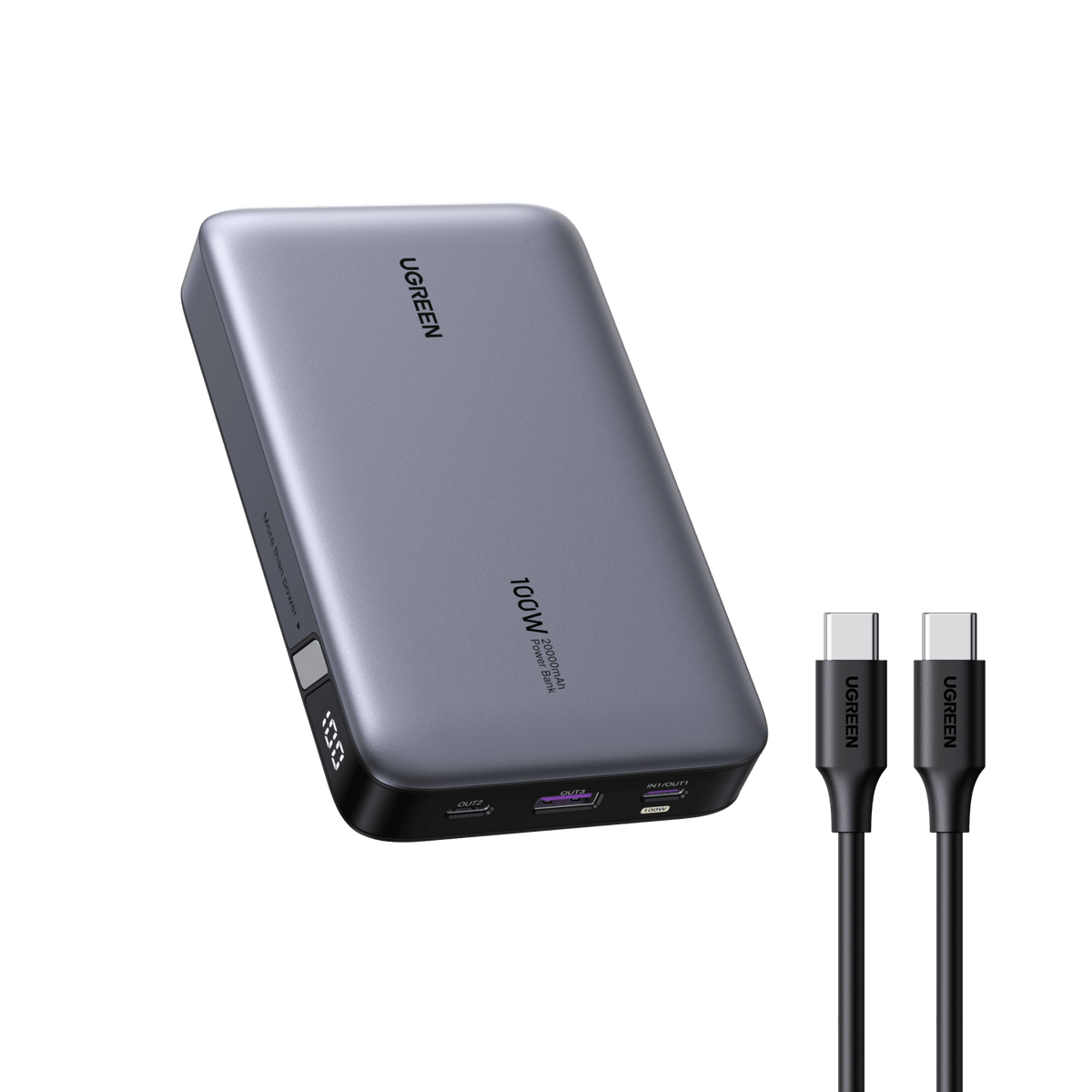
These two banks look similar on a spec sheet — both are USB-C power banks from trusted brands — but they are built for different bags. The Anker Nano (model A1259) is a 10,000mAh pocket bank with a built-in USB-C cable and a color display. The UGREEN Nexode 20000mAh is a 20,000mAh travel bank with two USB-C ports and one USB-A port and up to 100W total output. Capacity alone tells you the trade: the UGREEN holds twice the energy and weighs roughly twice as much.
| Feature | Anker Nano Power Bank 10K | UGREEN Nexode 20000mAh | Tech Gear Hub score |
|---|
| Capacity | 10,000mAh | 20,000mAh | Capacity: Nano 7/10, Nexode 9.5/10 |
| Max output | 30W (USB-C cable and port) | Up to 100W total, 100W single USB-C | Power: Nano 7.5/10, Nexode 9/10 |
| Ports | Built-in USB-C cable + USB-C + USB-A | 2x USB-C + 1x USB-A, 3 devices at once | — |
| Weight | 7.58 ounces (215 grams) | 14.8 ounces (419.5 grams) | Portability: Nano 9/10, Nexode 6.5/10 |
| Size | 4.09 x 2.06 x 1.02 inches | 5.47 x 3.23 x 1.02 inches | — |
| Recharge | 30W in, 50% in 45 minutes | 65W input on the main USB-C port | — |
| Display | Color display with charging status | Digital display | — |
| Best for | Phones, earbuds, everyday carry | Laptops, tablets, multi-device travel | Value: Nano 9/10, Nexode 8/10 |
The quotable numbers make the choice concrete: the Anker Nano weighs 7.58 ounces and measures 4.09 x 2.06 x 1.02 inches, while the UGREEN Nexode weighs 14.8 ounces and measures 5.47 x 3.23 x 1.02 inches. The UGREEN's 20,000mAh battery is double the Anker's 10,000mAh, and its 100W total output is more than triple the Anker's 30W. Both stay under the 100Wh airline carry-on limit, so both can fly in your cabin bag.
Size and weight: pocket vs bag
Weight is where most buyers should decide. At 7.58 ounces, the Anker Nano disappears into a jacket pocket or a small crossbody bag. It is roughly the size of a deck of cards, and because the USB-C cable is built in, you carry one object, not a bank plus a cable plus a dongle. That convenience is easy to underestimate until you have fished for a cable in a dark airport terminal.
At 14.8 ounces, the UGREEN Nexode is a bag bank, not a pocket bank. It fits fine in a backpack, a laptop sleeve or a carry-on, but it will drag down a trouser pocket and dominate a small purse. In return, you get a bank that can rescue a laptop as well as a phone. If your bag already holds a laptop, the extra 7 ounces over the Anker are barely noticeable. If your everyday carry is just a phone and keys, they are very noticeable.
Charging speed and ports
Speed follows the same split. The Anker Nano delivers 30W through its built-in cable and its USB-C port, and per Anker's official specs it recharges to 50% in 45 minutes and charges an iPhone 14 to 50% within 30 minutes. That is genuine fast charging for phones, tablets and earbuds — just not for laptops, which typically want 45W or more for full-speed charging.
The UGREEN Nexode is built for bigger loads. Its main USB-C port delivers up to 100W on its own, its second USB-C port up to 30W and its USB-A port up to 22.5W, with up to 100W total when devices share power, per Notebookcheck's breakdown of the UGREEN listing. That means a MacBook Pro can charge at near-full speed from one port while a phone tops up from another. When all three ports run together, power splits to roughly 65W, 10W and 10W — still enough for a laptop plus two small devices. The UGREEN also recharges faster than the Anker, with up to 65W input on its main port, so a big bank does not mean an overnight wait.
One honest caveat applies to both: headline watts are negotiated maximums, not guarantees. Your phone, cable and battery level all affect the real charging speed. Both banks support the common USB Power Delivery standard, so modern iPhones, Samsung phones, Pixels and USB-C tablets will fast-charge without proprietary chargers.
Everyday use: who each bank suits
For commuting, campus life, festivals and weekend trips, the Anker Nano is the easier companion. Two phone charges cover a long day, the built-in cable removes the most common failure point (a forgotten cable), and the color display shows charging status at a glance. It also pairs well with the phones in our other guides — if you just bought one of the budget Android phones we compared, the Nano is the matching pocket bank.
For work travel, creators and families, the UGREEN Nexode earns its weight. One bank that charges a laptop once, a phone four times and a tablet in between replaces two or three smaller banks and a wall charger. Parents charging two kids' devices on a road trip, students with a laptop and a phone, and remote workers on planes will all feel the difference. Our earlier comparison of the Anker Nano 10K vs Baseus Blade 20K covers a similar high-capacity trade-off, and our Nitecore NB10000 Gen 2 review covers the ultralight end of the same spectrum.
Price and value in the US
Both banks sit in the budget-to-midrange band for their classes, and both go on sale often — check the current price before you buy, because power-bank prices move weekly on Amazon. As a rule, the Anker Nano costs less than the UGREEN Nexode, and that gap is fair: you pay for half the capacity and a third of the output. The UGREEN's value case is that it replaces a laptop charger and a phone bank in one purchase. The Anker's value case is simpler: it is the cheapest way to never carry a dead phone again.
Check the current price of the Anker Nano Power Bank 10K on Amazon and check the current price of the UGREEN Nexode 20000mAh power bank on Amazon. Note that UGREEN sells several Nexode 20,000mAh variants — including a 165W retractable-cable model — so confirm the listing's wattage and ports match this guide (100W total, three ports) before ordering.
Who should buy each power bank
Buy the Anker Nano 10K if: you mainly charge a phone, you want the lightest bank that still fast-charges, you hate carrying separate cables, or you want a backup that lives in a jacket pocket.
Buy the UGREEN Nexode 20K if: you carry a laptop, you travel with two or three devices, you need 100W output, or you want one bank for a whole weekend instead of two smaller ones.
Who should NOT buy: do not buy the UGREEN if you only charge one phone and hate heavy pockets — you are paying for capacity you will carry but never use. Do not buy the Anker if your main device is a USB-C laptop — 30W will charge it slowly or merely hold its charge under load, and you will wish you had bought the UGREEN. And neither bank is a good pick for wireless MagSafe charging — if you want a magnetic snap-on bank, look at a dedicated MagSafe model instead, like the ones in our TORRAS MiniMag vs Nitecore comparison.
Frequently asked questions
Can the Anker Nano 10K charge a laptop?
It can trickle-charge a USB-C laptop at 30W, but it will not fast-charge most laptops. For laptop charging, the UGREEN Nexode 20K with up to 100W output is the better pick.
How many times can the UGREEN Nexode 20K charge an iPhone?
Up to four times for an iPhone 15 Pro, per Notebookcheck's coverage of the UGREEN listing. Real-world results vary with battery health, cable and background apps.
Is the UGREEN Nexode 20K allowed on planes?
Yes. Its 20,000mAh battery is rated at 72Wh, which is under the 100Wh carry-on limit for power banks. Keep it in your cabin bag, not checked luggage, and check your airline's rules.
Does the Anker Nano come with a cable?
Yes. The Anker Nano 10K has a built-in USB-C cable, plus a USB-C port and a USB-A port, so you can charge without carrying a separate cable.
Anker Nano vs UGREEN Nexode: which is better for travel?
For light travel with just a phone, the Anker Nano is better because it is half the weight. For laptop travel or multi-device trips, the UGREEN Nexode is better because of its 20,000mAh capacity and 100W output.
Which power bank recharges faster?
The UGREEN Nexode recharges faster, with up to 65W input on its main USB-C port, against 30W input on the Anker Nano. The Anker still reaches 50% in about 45 minutes because its battery is half the size.


Comments
Post a Comment