
By Tech Gear Hub • Last updated: November 14, 2026
Tech Gear Hub covers the technology that lands on your phone. Google's new AI model is now running behind the search box on every Android phone and iPhone in the US — here is what actually changed.
What happened
On November 12, 2026, Google introduced Gemini 4 Hydrogen, the third model in its Gemini 4 family after Argon and Carbon. The announcement came in two official Google blog posts on the same day: one from Koray Kavukcuoglu, senior vice president at Google DeepMind and Google's chief AI architect, and one from Robby Stein, vice president of product for Google Search.
Stein's post carried the line that matters most for regular users: "Today, Google Search is bringing cutting-edge intelligence to everyone with Gemini 4 Hydrogen. This is the biggest model upgrade to Search yet." The Verge's coverage of the launch quoted Stein the same way, and reported that Hydrogen is now the default model in AI Mode.
Hydrogen is rolling out globally across Google's developer, enterprise, and consumer surfaces: Google AI Studio (all tiers), the Gemini API, Gemini for business, the Gemini app, Google Search for all users, and Google Antigravity for paid Google AI Pro and Ultra subscribers. It is the first Gemini 4 model that free users get — the earlier Argon and Carbon models were aimed at paying subscribers and deep-reasoning work.
What is Gemini 4 Hydrogen?
Gemini 4 Hydrogen is Google's fast, everyday model in the Gemini 4 family. Google positions it as the execution model: while Carbon and Argon handle deep, long-horizon reasoning on the hardest problems, Hydrogen is built for rapid execution across everyday coding and agentic workflows — writing code, running tests, verifying changes, and answering multi-part questions quickly.
It succeeds Gemini 3.8 Flash, the model that has powered AI Mode since September 2026. Google says Hydrogen is priced flat across its entire 1 million-token context window at $1.50 per million input tokens and $7.50 per million output tokens — a developer price, not something consumers pay, since Search and the Gemini app remain free to use.
One genuinely new idea in Hydrogen is its four thinking levels: low, medium, high (the default), and a new xhigh tier. Google says the levels let the model scale reasoning depth to the task, so you only wait — and, for developers, only pay — for the depth a question actually needs.
What changes in Google Search
Search is where most people will meet Hydrogen, and Google lists four improvements in its Search post:
- Better understanding of intent: Search can now handle nuanced, complicated questions — including questions with multiple parts, hard-to-understand typos, or highly specific requests — and answer each part of the question.
- Improved query fan-out and linking: Hydrogen's reasoning supercharges query fan-out, running simultaneous queries across all the relevant subtopics. Google says this connects you to a broader range of helpful links than before, including sites you might not have discovered otherwise.
- More visual responses: More images, structured responses, comparison tables, and custom tools built for your question, delivered at search speed.
- Richer language understanding: More nuanced responses across all supported AI Mode languages, no matter what language you ask in.
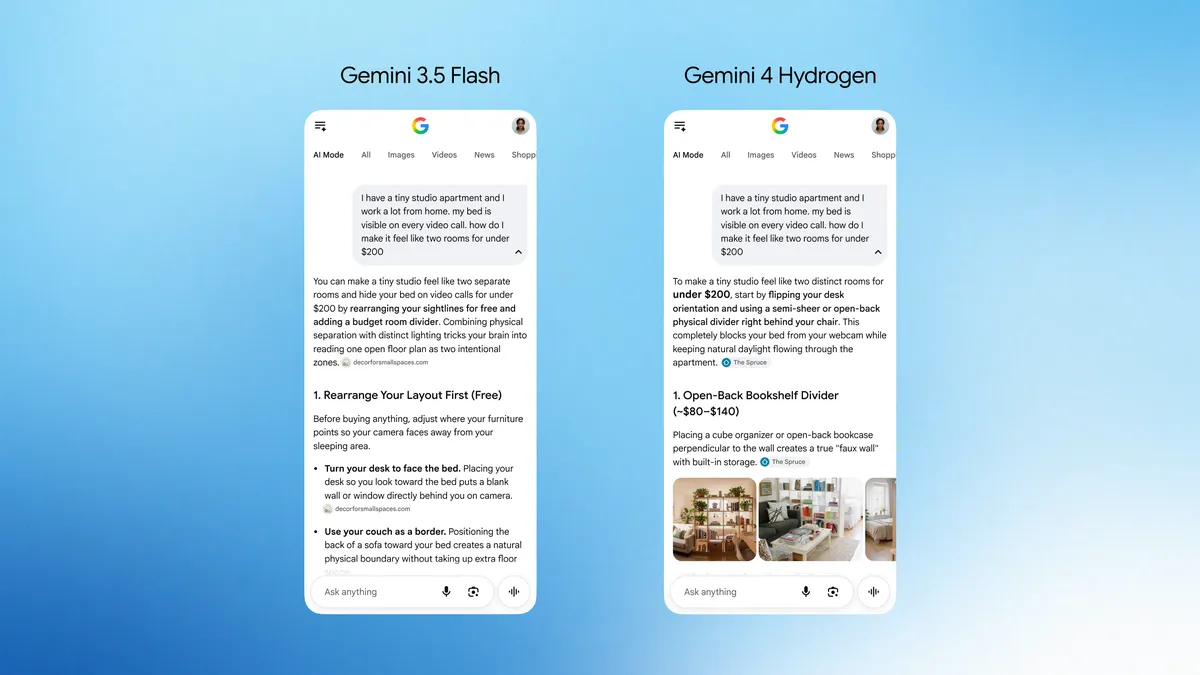
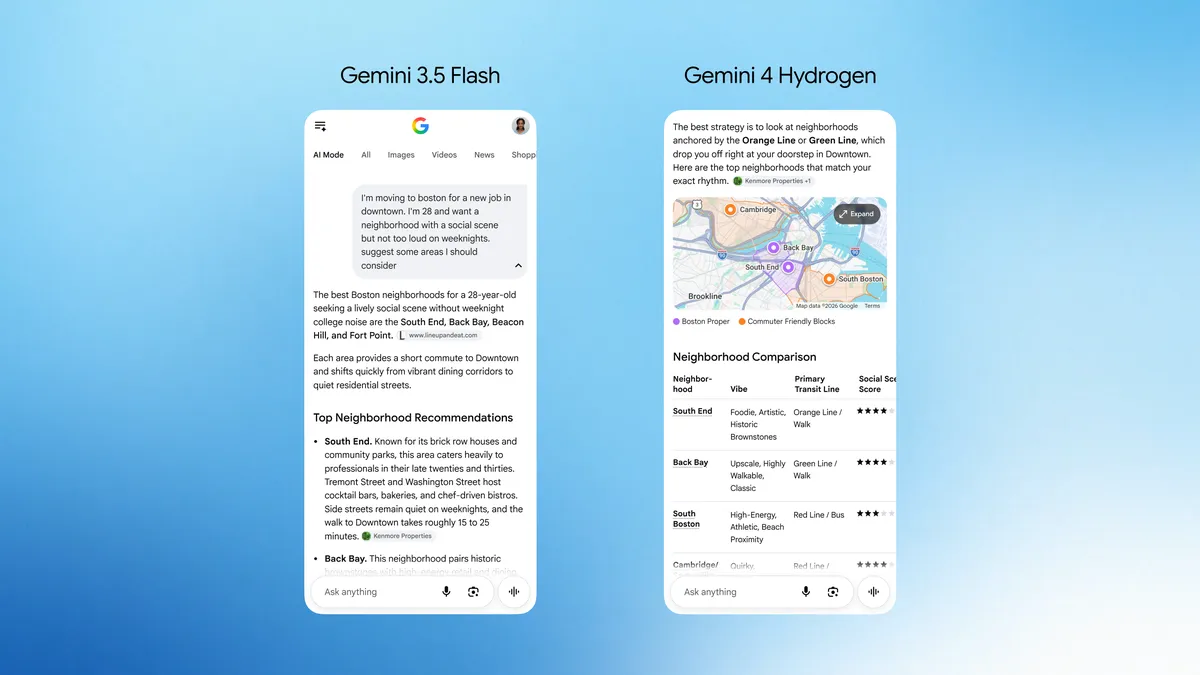
Google's own comparison images show the difference in practice: where Gemini 3.5 Flash gave a short text answer, Hydrogen returns a structured, visual breakdown — for example, a side-by-side comparison when you search for fixing an apartment or comparing Boston neighborhoods.
What changes in the Gemini app
In the Gemini app, Google says Hydrogen makes the everyday assistant more helpful in three ways: it follows your guidance and tone more closely, so drafts and documents come back ready to use on the first try; it connects the dots across your uploads, Gmail, Google Drive, and connected apps like Airtable and Dropbox; and it calls the right tools and skills more often, with less back-and-forth.
For Pixel owners, this lands on top of the November 2026 Pixel Drop, which brought Gemini Intelligence to the Pixel 10 series. Hydrogen is the model now doing that work behind the scenes. No new phone is required — the upgrade is server-side, and it reaches the Gemini app on both Android and iPhone.
The numbers Google claims
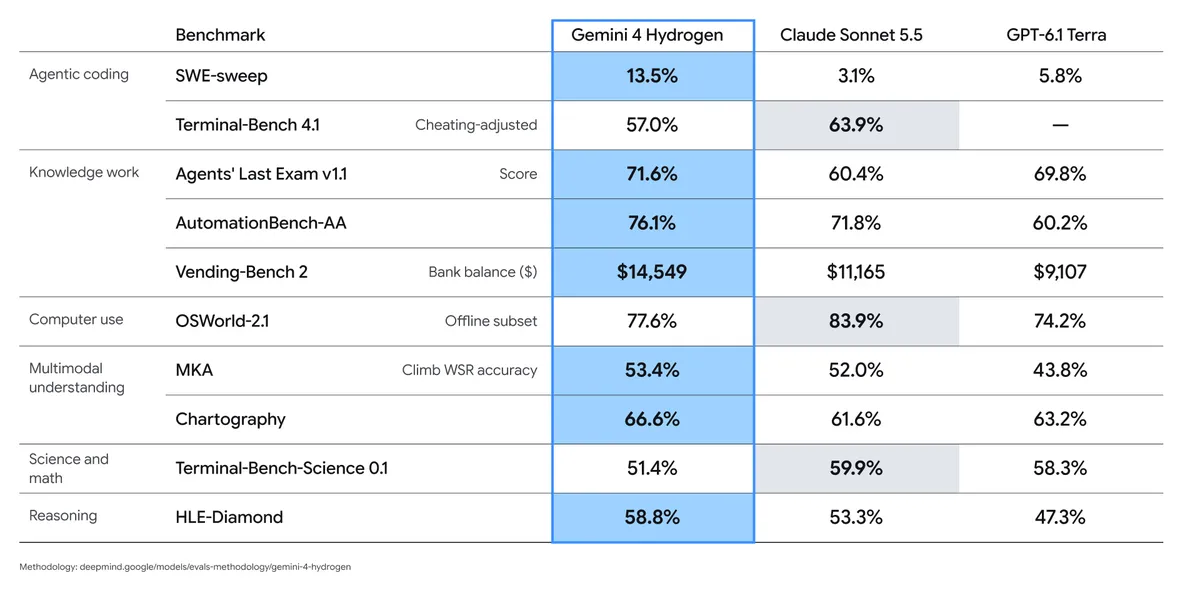
Every headline figure below comes from Google's own announcement. No independent benchmark has verified them yet, and that matters — treat them as Google's claims, not settled facts.
- 2.5 times faster than Gemini 3.8 Flash at finishing tasks, at its default high thinking setting.
- Terminal-Bench 4.1 score of 57%, against 18.2% for Gemini 3.8 Flash — more than triple, per Google.
- Artificial Analysis Intelligence Index: 51 at the default high setting (against Argon's 50), reaching 54 at the xhigh thinking level.
- 2x to 2.8x faster in early partner testing on complex enterprise workflows, with 12% to 23% lower token usage than 3.8 Flash.
- 1 million-token context window, with up to 1 million output tokens.
What it means for Pixel and Android users
For most readers, Hydrogen changes nothing you have to buy and nothing you have to install. It changes what you get when you ask Google a hard question. A long, messy, multi-part question — the kind you used to break into three separate searches — is now the exact case Hydrogen is built for. Comparison questions, "best X for Y under $Z" research, and typo-ridden voice queries should come back more structured and better linked.
Two practical things to try today: open AI Mode in Google Search and ask a genuinely complicated question, and open the Gemini app and pick Hydrogen from the model dropdown. If you own a Pixel, the timing is good — the Pixel 11 price cuts from the early holiday sales are still live, and the Pixel 10 series just received Gemini Intelligence in the November Pixel Drop.
One honest caveat: the November 2026 Google core update is rolling out at the same time, so regular search results are shifting this month too. If a result looks different this week, it may be the core update, Hydrogen, or both — Google has not said how to tell them apart.
What Google did not say
Google's Search post gives no benchmark numbers of its own, no latency figure, and no count of how many links Hydrogen surfaces. It does not say whether Hydrogen now writes every AI response in Search or only some, and it does not say what changes for subscribers who already choose between models in AI Mode. The model card and the DeepMind post carry the technical detail; the Search post is deliberately short.
The safety claims are also Google's own: Hydrogen reduces overreach in agentic tasks by up to 81% and cuts misaligned actions by 12x on Google's internal evaluations, with a 96.7% honesty rate on its internal agent honesty evaluation. Those numbers have not been independently replicated.
Who should care — and who should not
Care about this if you use Google Search's AI Mode, the Gemini app, or a Pixel phone — the upgrade is already live for you, free, with nothing to install. Developers and anyone building with the Gemini API should care too: Hydrogen is the new cheap-and-fast default, with a free API tier.
Do not worry about it if you only use Google for simple searches. A fast model behind the search box does not change a one-word lookup, and it is not a product you buy. And if you were hoping for a new Pixel or a new device announcement, this was not one — it was a model launch, not a hardware launch.
Frequently asked questions
What is Google Gemini 4 Hydrogen?
Gemini 4 Hydrogen is Google's fast, everyday AI model in the Gemini 4 family, announced November 12, 2026. It is built for speed and everyday tasks, and it now powers AI Mode and the hardest AI Overviews questions in Google Search.
Is Gemini 4 Hydrogen free to use?
Yes, for consumers. It is available to all Google Search users globally and in the Gemini app at no cost. Developers pay API prices of $1.50 per million input tokens and $7.50 per million output tokens.
How do I use Gemini 4 Hydrogen?
In Google Search, use AI Mode — Hydrogen is now the default model there. In the Gemini app, pick Hydrogen from the model dropdown. No app update or new phone is required.
Is Gemini 4 Hydrogen on Pixel phones?
Yes. Pixel phones use the Gemini app and Google Search, so Hydrogen reaches them through both. The November 2026 Pixel Drop also brought Gemini Intelligence to the Pixel 10 series, and Hydrogen is the model doing that work.
Is Gemini 4 Hydrogen better than ChatGPT?
Google has not published a head-to-head comparison with ChatGPT, and no independent benchmark has verified Hydrogen's claims yet. Google says it beats its own previous fast model, Gemini 3.8 Flash, by 2.5x on task speed — but that is a claim about its own models, not a comparison with rivals.
What are the four thinking levels?
Low, medium, high (the default), and a new xhigh tier. Higher levels use more reasoning for harder tasks; lower levels answer faster and cheaper. Google says the levels scale smoothly, so you only wait and pay for the depth a task needs.
Sources & references
- Google — Introducing Gemini 4 Hydrogen (Koray Kavukcuoglu, November 12, 2026)
- Google — Google Search gets a major upgrade with Gemini 4 Hydrogen (Robby Stein, November 12, 2026)
- The Verge — Google's Robby Stein calls Gemini 4 Hydrogen "the biggest model upgrade to Search yet" (November 12–13, 2026)
- ANI / The Hindu BusinessLine — Google rolls out Gemini 4 Hydrogen with 2.5x speed boost (November 13, 2026)


0 Comments